
Skip to content

PRAN Themed Research

Employment and Training    |    Entrepreneurship    |    Financial Literacy    |    Gender Relations    |    Parenting & Children        
Well-Being    |    Youth and Systems

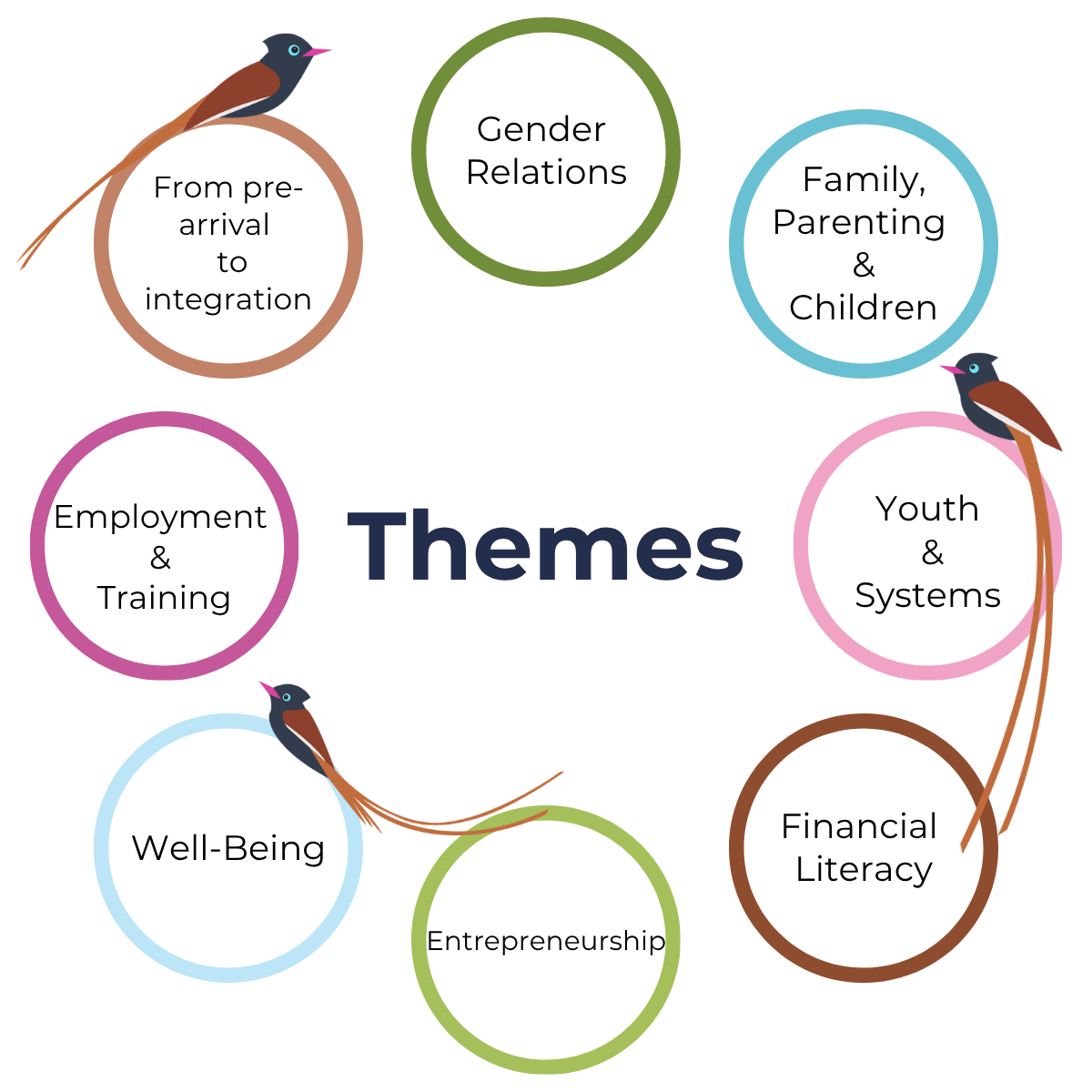
In Halifax, Montreal, Toronto, and Edmonton, PRAN members are researching, mobilizing results, and building capacity for students and partners. Eight themes linked to SSAI resilience and thriving characterize our work: 1) From pre-arrival to integration; 2) Gender relations; 3) Family, parenting, and children; 4) Youth and systems (schools, criminal justice, social services); 5) Entrepreneurship; 6) Financial literacy; 7) Employment and training; 8) Well-being.
 
On this page, you will find information on research projects related to one or more of these themes. Led by our research partners, team members, and students, these projects are separate from, but highly complementary to, the PRAN Core Research and Partner-Driven Activities.

Second generation Sub-Saharan African youth: Parental and family influences on post-secondary educational achievement in Ontario

Lead Researcher: Dr. Alana Butler, Associate Professor, Queen’s University

Project Summary

Research shows that Black Canadian students have graduated from high school and university at lower rates than their white counterparts.

According to Statistics Canada (2020):

      • Canadian-born men (25.7%) vs non-immigrant Black men (18%) earned a bachelor’s degree or higher,
      • Canadian-born women (41%) vs non-immigrant Black women (31%) have obtained a degree.

While limited, existing research tells us two important things about the educational experiences of African immigrants in Canada. First, African immigrants experience anti-Black racism in schools. Second, their parents have high expectations and aspirations for their success in schools. 

Building on the existing research, this project is focusing on second-generation Sub-Saharan African youth and the influence of their parents and families on their achievement of post-secondary degrees. The project is asking the following research questions: 

      1. What are the experiences of second-generation sub-Saharan African youth in Canadian post-secondary education?
      2. How have these youth been influenced by their sub-Saharan African immigrant parents and family members?
      3. How do youth demonstrate their resilience throughout their post-secondary educational journeys?

Methods

The project will conduct in-depth qualitative interviews with 40 second generation sub-Saharan African youth attending post-secondary institutions across Ontario.

Trainees

Two African immigrant doctoral students will be hired for the project. 

PRAN Themes

Parenting & Children    |    Youth & System   |    Gender Relations

FRAP Family to Family (F2F)

Lead Researcher: Dr. Philomina Okeke-Ihejirika, Professor, University of Alberta 
         Alphonse Ndem Ahola, Executive Director, FRAP

Project Summary

Family to Family (F2F): Exploring Diversity and Learning From One Another was a collaborative project between La Francophonie Canadienne Plurielle (FRAP) and PRAN. In conjunction with FRAP’s Settlement Workers in Schools (SWIS) program, F2F used PhotoVoice to explore issues of family and gender roles in supporting children’s education, among immigrant and refugee francophone families from sub-Saharan Africa and the Caribbean. With financing from an Ethnocultural Grant from the Government of Alberta, PRAN supported FRAP in staff training in PhotoVoice methodology.

To learn more about this project and its results, please see the PRAN Results page.

Methods

PhotoVoice is an innovative, participatory, arts-based qualitative research methodology. FRAP:

      • Facilitated three PhotoVoice workshops in April 2025 with 24 francophone men, women, and youth from West Africa and the Caribbean.
      • Hosted a community dialogue with PhotoVoice participants, FRAP SWIS staff, and school representatives in May 2025.
      • Held a project Exhibition, which highlighted the PhotoVoice materials for the community.

Trainees

FRAP Staff was trained in the PhotoVoice methodology. Training was also provided to FRAP Settlement Workers in Schools (SWIS).

Several QES scholars assisted at various stages of the F2F project. 

PRAN Themes

Parenting & Children    |    Youth & System

Key features of culturally inclusive, -affirming and contextually relevant mental health care and healing practices with Black Canadians: A scoping review

Lead Researcher: Dr. Sophie Yohani, Professor, University of Alberta

Project Summary

Researchers of Black mental health have linked experiences of everyday racism, microaggressions, and anti-Black racism to anxiety, depression, and trauma responses amongst Black Canadians (Cénat et al., 2021; 2023; Kogan, 2022). Echoing these concerns, the 2017 report of the United Nations (UN) Working Group of Experts on People of African Descent (UNPAD) highlighted the impact of systemic racism and discrimination on the rights of Black Canadians to economic, social, and cultural liberties (United Nations Human Rights Council, 2017).

Despite several national initiatives, there remains a gap in published research focusing on mental health interventions for and with Black Canadians. This scoping review examined current research on culturally and contextually informed mental health care and healing practices for Black individuals and communities in Canada. Researchers, educators, practitioners, and policymakers can use these insights to support more inclusive and responsive mental health care systems for Black Canadians.

Methods

Guided by Levac et al., the scoping review followed the PRISMA-ScR extension for scoping reviews and Arksey and O’Malley’s approach. The review included 34 articles, reporting only 30 because 6 of the original articles shared two samples. Three questions guided the review:

      1. What approaches to mental health care and healing have been used with Black Canadian populations?
      2. What are recommended practices for mental health care and healing with Black Canadians that are context and culturally informed?
      3. What gaps exist in the current knowledge of context and culturally informed mental health care and healing approaches with Black Canadians?


Articles were included based on the following inclusion criteria:

      1. includes African, Caribbean, and/or Black populations;
      2. involves a Canadian setting;
      3. describes a mental health healing practice; and
      4. discusses considerations made regarding culture and/or context.


The review excluded articles that had pharmacological interventions or insufficient content. Relevant data were extracted from the included articles using a standardized table with over 20 categories. Most articles (19) were from Ontario.

Trainees

Chloe Devereux, PRAN RA