
PRAN Results
On this page:
Partnership Research Results: Newcomer Survey | Community Institutional Scan | Longitudinal Qualitative Study | 1996-2021 SSAIs & the Canadian Census | SSAI-DEPT
Partner Driven Results: BEKH | Alberta’s Black Entrepreneurs | IPV Interventions in Alberta’s Black Communities | Family-to-Family (F2F) | FRAP Well-being & Safety
Partnership Research Results
Newcomers Survey
Project Summary | Project Results | Project Recommendations | Project Outputs
Project Summary
Project Results
Project Recommendations
Project Outputs
Community Institutional Scan
Project Summary | Project Results | Project Recommendations | Project Outputs
Project Summary
Project Results
Project Recommendations
Project Outputs
Longitudinal Qualitative Study
Project Summary | Project Results | Project Recommendations | Project Outputs
Project Summary
Project Results
Project Recommendations
Project Outputs
1996-2021 SSAIs & the Canadian Census
Project Summary
Over the past 25 years, the Sub-Saharan African immigrant (SSAI) population in Canada has tripled, increasing from 158,510 in 1996 to 537,370 in 2021. By 2021, Africa had become the second-largest source region for immigrants. No focused analysis has examined Sub-Saharan African immigrants (SSAIs) as a distinct group. Instead, analysis has included SSAIs either within the broader immigrant population or the growing population of Black Canadians. While practical, this incorporation without differentiation often obscures the unique experiences and rapid demographic growth of SSAIs within Canada.
The report, From 1996 to 2021: Analyzing the Transformation of the SSAI Population in Canada, begins to address this gap by examining the demographic transformation of SSAIs between 1996 and 2021, utilizing data from two Canadian censuses. The report examines SSAI demographics by province, metro area, language, age, gender, religion, and country of birth. The data was cleaned, organized, and analyzed using RStudio, enabling a detailed exploration of demographic trends and insights. For the analysis, the SSAI population was defined and determined using immigration and place of birth questions from the Census of Population.
Project Results
Concluding Thoughts
The SSAI population in Canada more than tripled between 1996 and 2021. While Ontario remains a key destination, the Prairies and Atlantic Canada are attracting an increasing number of SSAIs. As newcomers, SSAIs bring diverse skills, cultures, languages, and perspectives that enrich Canadian society and economic diversity. These trends underscore the need for ongoing efforts to support the integration of SSAIs nationwide, with notable implications for policy and integration strategies.
Project Outputs
SSAIs-DEPT
Partner Driven Results
BEKH
Examining the Patterns of Entrepreneurship Among Visible Minorities in Canada: A Scoping Review
Project Summary
In the fall of 2024, PRAN completed a scoping review project in collaboration with the Black Entrepreneurship Knowledge Hub (BEKH). The scoping review explores the experiences of visible minority entrepreneurs in Canada through an intersectional lens. Race, gender, class, education, and economic status were some factors examined. Key themes include push and pull factors, the role of social networks and capital, transnationalism, visible minority women entrepreneurs, and financing. The review concludes with key recommendations for research, practice, and policy.
For the scoping review, the research team examined 46 articles guided by 3 questions:
- What do we currently know about entrepreneurship among visible minorities?
- How does existing knowledge specifically address Black entrepreneurship?
- How can these insights inform future research, policy, and practice?
Only English-language articles were included, with no restriction on publication year.
Project Recommendations
Future research agendas should:
- Expand research focus
- Implement intersectional analysis
- Improve data collection
- Enhance financial access
- Address systemic barriers
Project Outputs
A journal article and research brief are underway, with publication anticipated for 2026.
Project Results
Key Themes
desire for independence, recognizing market opportunities, and leveraging ethnic networks. The review found that an increasing number of visible minorities in Canada are becoming entrepreneurs due to proactive pull factors rather than traditional push factors.
Examining the Patterns Among Black Entrepreneurs in U.S., Australia and New Zealand: A Scoping Review
Project Summary
Building on the results of the visible minority entrepreneurship scoping review, PRAN completed a second project—a scoping review on Black and Sub-Saharan African Immigrant entrepreneurship in the United States, Australia, and New Zealand. The project reviewed 74 articles exploring how multiple intersecting vectors of identity and inequities contribute to the marginalization and successes of Black entrepreneurs. Of the included articles, the most frequently studied population was African Americans, followed by African and Caribbean immigrants in the United States. Three articles featured studies looking at both African Americans and African and Caribbean immigrants in the United States. African immigrants in New Zealand were the focus of two included articles; one study looked at African immigrants in Australia.
Project Results
Key Themes
For U.S.-born Black entrepreneurs, entrepreneurship is shaped by both push factors (discrimination, blocked mobility) and pull factors (desire for autonomy, economic improvement). Discrimination and capital intersect for both U.S.-born and Sub-Saharan African-born entrepreneurs. U.S.-born entrepreneurs often respond by leveraging community networks for capital. Sub-Saharan African-born entrepreneurs may have reduced net worth and encounter unfavourable borrowing terms.
In the U.S, residential segregation concentrates poverty geographically, limiting opportunities,
reducing local purchasing power, and effectively isolating communities from broader economic networks. This negatively impacts entrepreneurship and creates an unfavourable environment for business growth. Social segregation, which is tied to residential segregation, occurs when cross-group social interaction is impeded. Social segregation impacts entrepreneurs by limiting access to information, resources, and business role models. It may also pressure entrepreneurs to prioritize addressing the community’s social challenges over pursuing individual business opportunities
U.S.-born Black entrepreneurs encounter persistent lending discrimination. Black entrepreneurs in the U.S have less initial capital for their start-ups, are more likely to rely on personal savings, and are less likely to seek bank loans due to a fear of rejection than their White counterparts. Wealth inequality compounds these challenges, further reducing start-up capital and access to loans and external investment. Black women entrepreneurs often face “double discrimination” through the intersection of racial and gender discrimination. However, women demonstrate remarkable resilience shaped by strong ethnic and gender identities.
Project Recommendations
- Address gaps in research on Black entrepreneurship in the U.S, Australia, and New Zealand
- Policies that support Black entrepreneurs, such as:
- low-interest loans
- grant programs
- mentorship networks
- supplier diversity initiatives
- educational programs
- enforcement against discriminatory lending practices.
Project Outputs
A journal article and research brief are underway, with publication anticipated for 2026.
Alberta's Black Entrepreneurs
Project Summary
Project Results
Results—The Survey
Of the 326 entrepreneurs invited to participate in the study, 232 consented to and completed the survey. Many participants were male, nearly half were born in Canada, most were 45 years old or younger, and 90.1% had at least a high school education.
Increasing personal/family wealth was the most common reason for starting a business. The third most common reason was taking advantage of a business opportunity. The most common challenges when initially
starting their businesses were related to the availability of credit and/or loans, the availability and/or cost of labor, and a lack of entrepreneurial/business training.
Results—The Interviews
Social Capital: The interviews revealed that Black entrepreneurs in Alberta start at a social capital disadvantage as they are less likely to be part of professional business networks and a majority have limited access to business, social, or family networks more broadly. This limits their access to information, mentorship, financing, and other valuable resources.
Financial Capital: The greatest challenge facing Black entrepreneurs in Canada remains accessing startup capital and growth capital. As a result, Black entrepreneurs are forced to rely on personal savings and credit cards.
Discrimination: During the interviews, many Black entrepreneurs mentioned difficulties selling products and services to non-Black consumers, leaving many stuck in ethnic markets. More than half felt that racial attitudes impacted their ability to grow their business, including “not being taken seriously” as a Black business owner by White and other non-Black people.
Project Recommendations
Black entrepreneurs must leverage existing networks within the Black community and participate in the growing network of professional entrepreneurial linkages, associations, and organizations.
Black community organizations interested in fostering entrepreneurship must help build upon these networks.
Additionally, workshops and training programs that provide business-relevant skills (human capital) may improve outcomes for Black entrepreneurs.
Project Outputs
The valuable insights derived from this initial data played a pivotal role in shaping a comprehensive report for Africa Centre, as well as multiple manuscripts.
Publication: Black entrepreneurship in Western Canada: the push and pull factors
A second publication is currently in press, and a third is coming soon!
IPV Interventions in Alberta’s Black Communities
Project Summary
From March 2022 to March 2024, PRAN collaborated with Africa Centre to create and implement a framework for IPV prevention. The Successful Initiatives to Address Intimate Partner Violence against Women and Girls in Alberta’s Black Communities (IPV Project) was funded by Women and Gender Equality Canada (WAGE). PRAN members Dr. Okeke-Ihejirika and Dr. Yohani led the project.
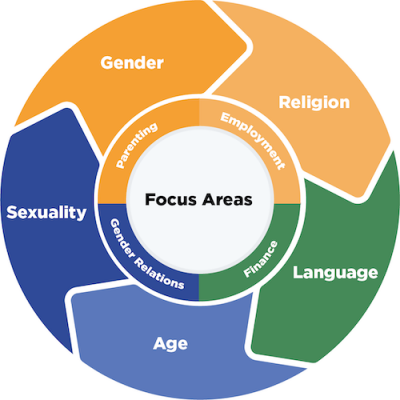
The IPV Project conducted a rapid narrative review and four focus group discussions, and engaged a Working Group. Four pillars (Gender Relations; Employment, Education, and Training; Parenting; and Financial Literacy) and five key facets (gender, religion, language, age, and sexuality) anchored the project. Pillars, facets, research, and insights from the Working Group informed the project’s framework and toolkit.
Project Results
Results—Collaboration
The IPV Project engaged 105 collaborators during development and over 3100 people during implementation. Engagement with ACB communities and organizations increased awareness, understanding, and knowledge of IPV and healthy gender relations.
The framework and toolkit include a series of activities and shareable materials (events, workshops, podcast, animated videos, pamphlets, service provider handbook, and framework report). These activities and materials drove a lot of engagement and were created in collaboration with community members.
Results—Community Views
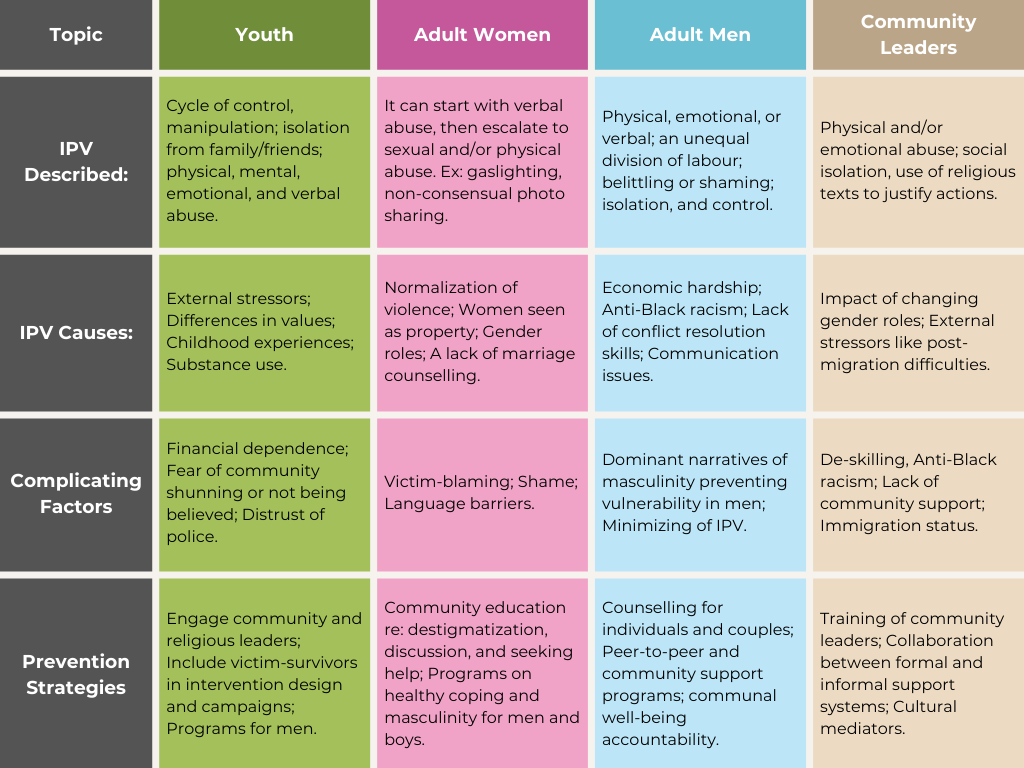
To understand the current Alberta context, the IPV project team engaged community members from major demographic groups to learn more about the community’s views. Funded by a Killam Research Fund Connection grant, four focus group discussions (FGD) were held involving youth, adult women, adult men, and community leaders. Below is a table of key themes from the discussions.
Overlapping themes and discussion points between groups were removed for simplicity. Please see our Framework report for a more complete version of the table and additional details.
Project Outcomes
Three significant IPV Project outcomes:
- Strengthened and built of the gender program and staff at Africa Centre,
- Increased awareness of IPV and healthy gender relations among ACB communities,
- Increased networking and collaboration among project partners and organizations.
Rich insights and lessons on language, collaboration, and community engagement were learned through the IPV Project.
Project Outputs
In addition to the IPV Project Framework report, the team also developed a series of animated videos, pamphlets, and a podcast. Access those resources on our Tools webpage.

FRAP Family to Family (F2F)
Project Summary
Family to Family (F2F): Exploring Diversity and Learning From One Another was a collaborative project between La Francophonie Canadienne Plurielle (FRAP) and PRAN. In conjunction with FRAP’s Settlement Workers in Schools (SWIS) program, F2F used PhotoVoice to explore issues of family and gender roles in supporting children’s education, among immigrant and refugee francophone families from sub-Saharan Africa and the Caribbean. PhotoVoice is an innovative, participatory, arts-based qualitative research methodology. With financing from an Ethnocultural Grant from the Government of Alberta, PRAN supported FRAP in staff training in PhotoVoice methodology.
Through F2F, FRAP:
- Facilitated three PhotoVoice workshops in April 2025 with 24 francophone men, women, and youth from West Africa and the Caribbean.
- Hosted a community dialogue with PhotoVoice participants, FRAP SWIS staff, and school representatives in May 2025.
- Held a project Exhibition, which highlighted the PhotoVoice materials for the community.
Project Results
F2F, a community-based project, facilitated intercultural exchange among African, Caribbean, and Albertan francophone families, schools, and organizations. The project primarily focused on one of the most significant challenges for newcomer francophone families: supporting their children’s adjustment to and success in Alberta schools. F2F engaged racialized men, women, youth, seniors, and newcomers. Approximately 54 people were directly involved in the project as participants, facilitators, volunteers, project team members, and other stakeholders, including school principals, settlement workers, and francophone organizations. An additional 250 people were indirectly engaged through this project via the dissemination of materials and the exhibit.
Project Outcomes & Outputs
Materials produced for and through the project will be further analyzed to support the development of FRAP services and programming with families and Alberta’s francophone schools. Workshop and community dialogue participants shared overwhelmingly positive feedback, and other stakeholders have expressed interest in expanding the exhibit. Based on this interest, plans are underway to extend the exhibition’s reach to new audiences across Alberta. We anticipate that the number of people engaged indirectly through this project will grow significantly when the exhibit has a more permanent home. A subsequent project webinar will also be held to highlight the project’s successes. Click here to view photos from the project on our Gallery page.
FRAP Well-Being & Safety
Project Summary
With funding from Immigration, Refugees and Citizenship Canada (IRCC) through the Edmonton Local Immigration Partnerships (ELIP), Francophonie Canadienne Plurielle (FRAP) led this two-year project in collaboration with PRAN and Dr. Philomina Okeke-Ihejirika. The main purpose of Alberta’s Black Immigrant Communities Safety & Well-being project (Well-being Project) was to identify key factors impacting the well-being and safety of the communities that FRAP serves.
The Well-being Project began with community gatherings, consultations with service providers, and the sharing of research findings. Four focus group discussions with 12-14 participants each were held between February 2022 and March 2023. The focus groups identified areas for research, which informed the project questionnaire:
- Barriers to accessing social services
- Challenges with professional integration
- Social and cultural isolation, identity, and identification
- Francophone ethnocultural immigrant communities as minorities within already marginalized populations
- Strengths the Black community brings to face these challenges.
The questionnaire, available in English and French, was distributed through online platforms, community leader outreach, and events. and extended to the entire Black ethnocultural immigrant population of Alberta.
Project Results
Black Francophone newcomers experience transition and integration struggles as minorities within the larger populations of Black Albertans, francophones, and newcomers. Community leaders emphasized that these systematic markers of marginalization and exclusion are more pronounced and felt acutely by those residing in English-speaking provinces, such as Alberta. The survey data highlights the importance of providing newcomers with accessible and informative resources to support their integration into Canada. Specifically, respondents identified key areas of concern, such as employment, education, the legal system, the banking and loan system, taxation, and healthcare.
Results from the survey were analyzed first by the total number of Black participants and then by Francophone participants as a portion of all participants. Overall, more women completed the survey than men, many respondents indicated Africa as their place of origin, and a significant number of respondents hold either a bachelor’s degree or a graduate degree. Figure 1 to the right compares the demographic information of survey participants.
More than half (62%) of participants view international migration as an opportunity to build a better life, but noted several challenges. For both Black participants and the Francophone portion of participants, Canadian work experience was a significant obstacle to employment. As for challenges faced by the Black community, Black participants and the Francophone portion of participants noted racial, cultural, or religious discrimination as well as communication and language barriers as significant challenges.
In terms of children, most respondents (over 50%) perceive factors such as being able to freely speak an African language, forging their own identity, combating racism, having Black role models, embracing cultural heritage, and accessing more educational opportunities as important for the future of Black children in Canada.
Project Recommendations
- Address systemic inequities and promote inclusivity within Canadian society.
- Apply holistic approaches to Black immigrant health and well-being.
- Increase training for service providers to understand the diverse needs of the Black community.
- Build community out of shared commonalities.
- Support economic empowerment.
- Promote Black entrepreneurship.
Project Outputs
- Survey report for FRAP
- Research Brief, coming soon.
Family-to-Family (F2F)
FRAP Well-being & Safety
page 6-7
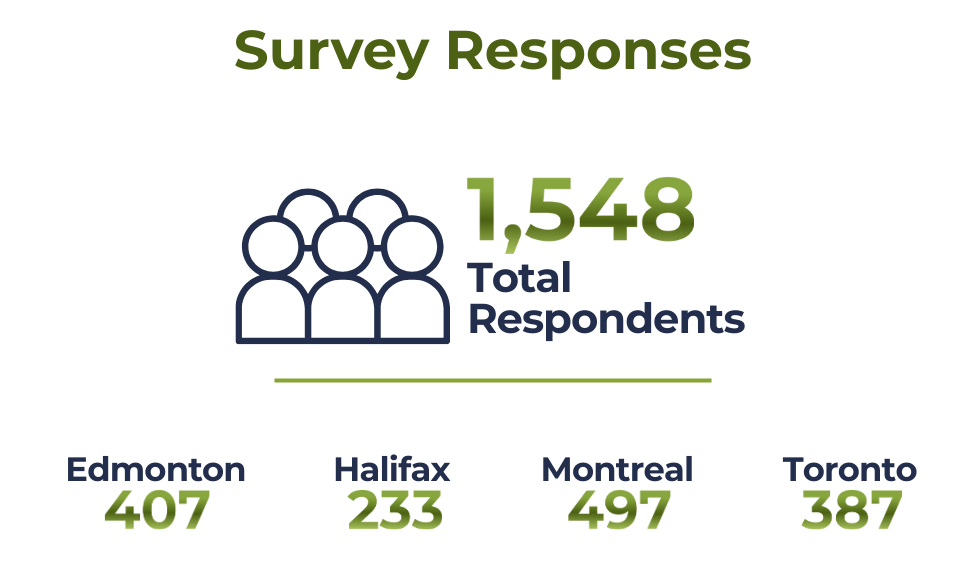
National Numbers
Something here about this being national overview
graphic + description
graphic + description
graphic + description
graphic + description
By City
Edmonton Halifax. Montreal. Toronto. (links)